

Goat farming has a cost problem that few people talk about. Feed.
In many regions, goat farmers buy commercial feed at prices that leave little margin. The feed is convenient, consistent, and available. But it is also expensive, and the cost keeps rising. For small farms with 50 to 300 animals, feed can account for more than half of total operating costs.
Some farmers have started asking a different question. Instead of buying feed, can they make it themselves?
The answer is not simple. It depends on the farm size, the available raw materials, the labor situation, and the willingness to learn a new process. But for many small goat farms, on-farm feed production is not only possible. It is practical.
This article looks at what it takes to make goat feed on a small farm, what equipment is needed, what raw materials work well, and what the economics actually look like.
Why Goat Feed Is Different from Other Livestock Feed
Goats are ruminants. They have a four-chambered stomach and a digestive system designed to break down fibrous plant material. This makes them different from pigs and poultry, which rely more on concentrated feed.
A goat’s diet in a natural setting consists mostly of browse: leaves, shrubs, weeds, and roughage. In a farm setting, this is supplemented with hay, silage, and concentrated feed. The concentrated portion is where feed production comes in.
Goat feed pellets typically combine several ingredients. Energy sources like corn, barley, and wheat bran provide calories. Protein sources like soybean meal, cottonseed meal, and sunflower meal support growth and milk production. Minerals and vitamins fill nutritional gaps. Roughage in ground form is often included to support rumen function.
The goal is not to replace forage entirely. Goats still need long-stem roughage for proper rumen health. The pellet is a supplement, not the whole diet. But a well-formulated pellet can improve growth rates, milk yield, and overall animal health.
This distinction matters for feed production. Goat feed is not the same as cattle feed, sheep feed, or poultry feed. The formula, the pellet size, and the processing parameters all differ. A farmer who tries to use poultry feed equipment for goat feed will run into problems.
What Small Farms Actually Need
The equipment requirements for a small goat farm are different from those of a commercial feed mill.
A commercial mill might produce 10 to 20 tons per hour and run continuously. A small farm might need 1 to 2 tons per hour and operate only a few days per week. The equipment must match this scale.
For a small farm, the basic process includes grinding, mixing, pelletizing, and cooling. Some farms also include drying, depending on the moisture content of the raw materials and the local climate.
Grinding reduces raw materials to a consistent particle size. A hammer mill is the most common choice for small farms. It is simple, durable, and relatively inexpensive. The screen size determines the final particle size, and different screens can be used for different ingredients.
Mixing blends the ingredients into a uniform batch. A horizontal mixer or a vertical mixer can be used, depending on the capacity and the desired level of uniformity. For goat feed, uniformity matters because the formula includes minerals and additives at low inclusion rates.
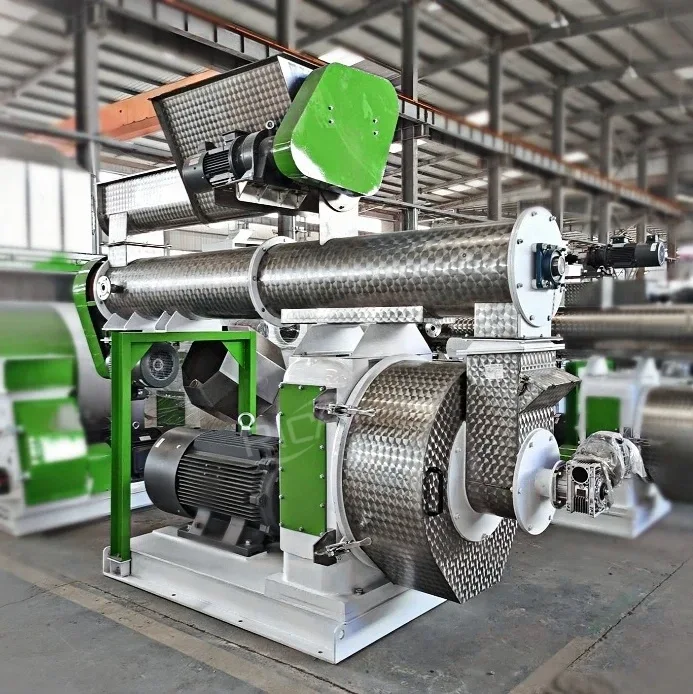
Pelletizing forms the mixed feed into pellets. A pellet mill, also called a pellet press, uses pressure and heat to compress the feed through a die. The die size determines the pellet diameter. For goats, a pellet size of 4 to 8 mm is common, depending on the age and size of the animals.
Cooling reduces the pellet temperature after pressing. Hot pellets are soft and fragile. Cooling hardens them and improves durability. A simple counterflow cooler is usually sufficient for small-scale production.
Drying may be needed if the raw materials have high moisture content. In most cases, the pelletizing process generates enough heat to reduce moisture, but additional drying may be required in humid climates.
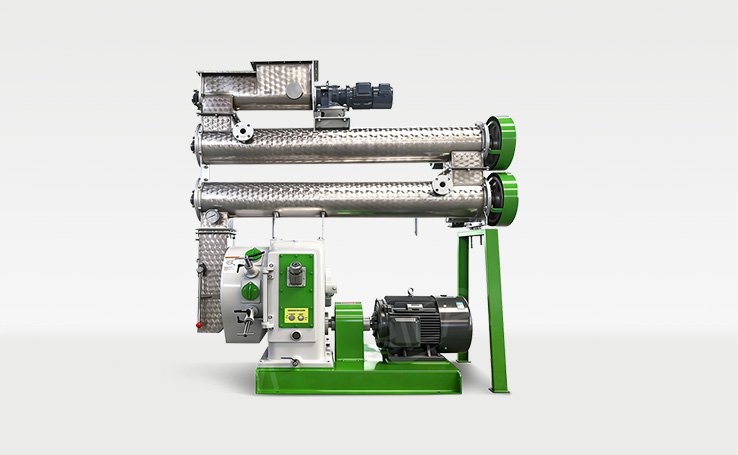
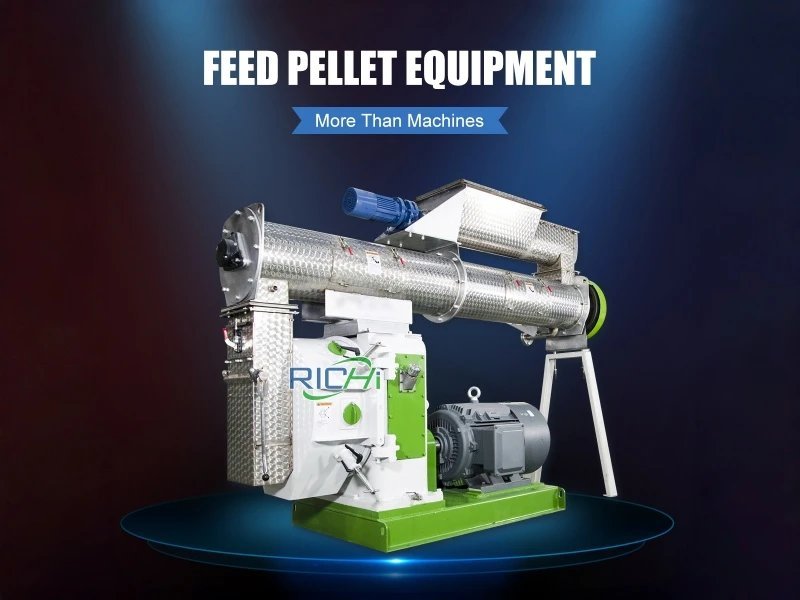
For a farm producing 1 to 2 tons per hour, a goat feed pellet making machine with matching grinding, mixing, and cooling equipment forms a complete small-scale line. The equipment can be configured for different capacities and different levels of automation.
Some farmers start with a smaller setup and expand later. Others invest in a complete line from the beginning. The right choice depends on the farm’s current needs and future plans.
What Raw Materials Can Be Used
One of the main advantages of on-farm feed production is the ability to use locally available raw materials. This reduces cost and improves supply reliability.
Energy sources include corn, barley, wheat, oats, and wheat bran. These are widely available in most regions. Corn is a common energy source in goat feed, but it should be balanced with other ingredients to avoid excessive starch.
Protein sources include soybean meal, cottonseed meal, sunflower meal, rapeseed meal, and peanut meal. The choice depends on local availability and price. Soybean meal is the most common, but it is also one of the more expensive options.
Roughage sources include alfalfa meal, hay meal, and ground straw. These provide fiber and support rumen health. They also affect pellet quality, because high-fiber ingredients can be difficult to pelletize.
Mineral and vitamin supplements are included at low rates but are important for animal health. Calcium, phosphorus, and salt are common mineral additions. Vitamin premixes support growth, reproduction, and immunity.
Additives such as binders, mold inhibitors, and antioxidants may be used to improve pellet quality and storage life. Binders help hold the pellet together, especially when the formula includes high levels of roughage.
The exact formula depends on the animals’ age, weight, production stage, and purpose. A dairy goat has different nutritional needs than a meat goat. A growing kid has different needs than a mature doe. Feed formulation should be adjusted accordingly.
For farmers who are new to feed production, working with a nutritionist or an experienced feed formulator is worthwhile. A poorly balanced formula can reduce animal performance and waste money.
The Economics of On-Farm Feed Production
The main reason farmers consider on-farm feed production is cost. But the economics are not always as simple as they appear.
The savings come from three sources. First, the farmer avoids the feed mill’s margin and distribution costs. Second, the farmer can use lower-cost local ingredients instead of buying finished feed. Third, the farmer can adjust the formula to match the animals’ needs more precisely.
The costs include equipment, labor, energy, maintenance, and raw materials. For a small farm, the equipment cost is the most significant upfront expense. Labor and energy are ongoing costs.
Whether on-farm production saves money depends on several factors. The farm must have access to reasonably priced raw materials. It must have enough animals to justify the equipment. It must have labor available to operate the line. And it must be able to produce feed that performs as well as commercial feed.
For farms with 100 or more goats, on-farm production often makes economic sense. For smaller farms, the fixed costs may be too high unless the farm can share equipment with neighbors or buy raw materials at a very low cost.
A 1-2 T/H goat feed pellet making machine for small farms is sized for this type of operation. It is large enough to produce meaningful quantities but small enough to be affordable and manageable. The payback period depends on the difference between the cost of producing feed and the cost of buying it.
What to Consider Before Investing
Before investing in feed production equipment, several questions should be answered.
How many animals will the feed serve? This determines the required capacity. A farm with 200 goats needs more feed than a farm with 50 goats.
What raw materials are available locally? The formula should be built around what is available and affordable, not around an ideal formula that requires imported ingredients.
What is the current feed cost? This provides a baseline for comparison. If commercial feed is cheap and readily available, the savings from on-farm production may be limited.
What is the labor situation? Feed production requires time and attention. If labor is scarce or expensive, this affects the economics.
What is the available space? A feed line needs space for equipment, raw material storage, and finished product storage. This should be planned before ordering equipment.
What is the power supply? Pellet mills and hammer mills require significant power. The site must have adequate electrical capacity.
What level of automation is appropriate? Manual operation is cheaper but requires more labor. Automated operation costs more but reduces labor and improves consistency.
What support is available? Installation, training, and after-sales service are important. A supplier who provides these is more valuable than one who only sells equipment.
These questions should be answered before requesting a quotation. A supplier who understands the farm’s situation can recommend appropriate equipment and avoid over- or under-sizing.
Setting Up a Small Feed Line
A small goat feed line is not just a pellet mill. It is a system that includes several components.
Raw material storage should protect ingredients from moisture, pests, and contamination. Silos, bins, or covered storage areas can be used, depending on the scale and the local climate.
Grinding equipment reduces raw materials to the required particle size. A hammer mill with interchangeable screens is a common choice for small farms.
Mixing equipment blends the ingredients into a uniform batch. The mixer capacity should match the pellet mill capacity to avoid bottlenecks.
Conveying equipment moves materials between stages. Bucket elevators, screw conveyors, and belt conveyors are common options. The choice depends on the material characteristics and the layout.
Pelletizing equipment forms the feed into pellets. The pellet mill should be sized to match the required capacity and the desired pellet size.
Cooling equipment reduces the pellet temperature after pressing. This improves durability and prevents condensation during storage.
Packaging equipment fills bags or containers for storage or sale. For on-farm use, simple bagging equipment is usually sufficient.
The layout of the line affects efficiency and maintenance. A well-designed layout minimizes material handling and provides access for maintenance and cleaning. A poorly designed layout creates bottlenecks and makes routine tasks difficult.
For farmers who are planning a new line, working with a supplier who can provide layout design and equipment integration is usually more efficient than buying individual machines from different sources.
For more information on animal feed equipment options, including equipment for different livestock species, the page at https://pelletmakermachine.com/animal-feed-machine/ provides an overview of available solutions.
Choosing the Right Equipment Partner
Equipment is only part of a successful feed production project. The supplier behind the equipment matters just as much. A manufacturer who understands small-farm operations can recommend a line that fits the farm’s capacity, raw materials, and budget, rather than pushing a standard package that may not suit the situation.
For small goat farms, the ideal partner is one who can provide not only the goat feed pellet making machine but also guidance on layout, formulation, installation, and operator training. This kind of support reduces the learning curve and helps the farm get to consistent production faster. Manufacturers such as Richi Machinery focus on animal feed equipment for a range of livestock operations, from small farms to larger commercial mills, and can help match equipment to the actual scale of the project.
Common Mistakes in Small-Scale Feed Production
Several mistakes appear repeatedly when small farms start producing their own feed.
Choosing the wrong capacity. Equipment that is too small limits production and requires frequent operation. Equipment that is too large wastes money and energy.
Ignoring raw material quality. Poor-quality raw materials produce poor-quality feed. Incoming materials should be inspected and tested.
Skipping formulation. Feed formulation is not guesswork. A balanced formula is essential for animal performance.
Underestimating labor. Feed production takes time. If labor is not planned for, the line will not be used consistently.
Neglecting maintenance. Pellet mill dies, hammers, and screens wear out. Regular maintenance keeps the line running.
Poor storage. Feed that is stored improperly loses quality and may become unsafe. Storage conditions should be controlled.
No quality testing. Feed quality should be checked regularly. Simple tests for moisture, pellet durability, and water stability can catch problems early.
Avoiding these mistakes requires planning and attention. But it is not complicated. The basics matter more than advanced technology.
Pellet Quality for Goats
Goat feed pellets should be durable, palatable, and appropriately sized.
Durability affects how well the pellet survives handling and storage. A durable pellet produces fewer fines, which means less waste and better intake.
Palatability affects how readily goats eat the feed. Goats are selective eaters. If the feed does not smell and taste right, they may reject it.
Pellet size should match the animals. Smaller pellets are suitable for young goats, while larger pellets are suitable for mature animals. A pellet size of 4 to 8 mm is common for goats.
Hardness matters too. Pellets that are too hard may be difficult for goats to chew. Pellets that are too soft may break apart during handling.
The pelletizing process affects all of these properties. Moisture content, die size, compression ratio, and cooling all play a role. Adjusting these variables is part of the learning curve for new feed producers.
The Role of Forage
It is important to remember that pellets are not the whole diet for goats. Forage remains essential.
Goats need long-stem roughage to maintain proper rumen function. Without it, they can develop digestive problems. The pellet supplements the forage, providing concentrated nutrients that forage alone may not supply.
This means that feed production on a goat farm should be integrated with a forage program. The farm should have adequate pasture, hay, or silage to meet the animals’ roughage needs. The pellet is an addition, not a replacement.
Some farms produce both forage and pellets. Others buy forage and produce only the concentrated portion. The balance depends on the farm’s resources and the animals’ requirements.
Scaling Up Over Time
Many small farms start with a basic feed line and expand as they gain experience.
The first step is usually a small pellet mill with basic grinding and mixing equipment. This allows the farm to test the concept and learn the process.
As the farm grows, additional equipment can be added. A larger mixer, a more efficient grinder, or an automated control system can improve capacity and consistency.
The key is to plan for expansion from the beginning. Equipment that cannot be expanded becomes a bottleneck. Equipment that is designed for expansion can be upgraded as needed.
For farmers who are unsure about the right capacity, starting slightly larger than current need is usually better than starting too small. The additional cost is modest, and the extra capacity provides room for growth.
Final Thoughts
On-farm feed production is not for every goat farm. It requires investment, labor, and a willingness to learn. But for farms with enough animals and access to affordable raw materials, it can reduce costs and improve control over feed quality.
The goat feed pellet making machine is the center of the system, but it is not the whole system. Grinding, mixing, cooling, and storage all matter. So does formulation, raw material quality, and animal management.
For small farms, the decision comes down to economics and practicality. If the numbers work and the farm is ready to take on the work, on-farm feed production can be a valuable addition to the operation. If not, buying commercial feed remains a reasonable choice.
The farms that succeed with on-farm production are the ones that plan carefully, start at the right scale, and pay attention to quality. Those are the fundamentals that matter, regardless of the equipment used.