


Why Are Cattle Feed Pellets Becoming More Popular?
Cattle feed is often made from a mixture of grains, forage, protein sources, minerals, and other nutritional ingredients. Traditionally, many farms have relied on loose feed or separately prepared ingredients. However, pelleting has become increasingly common because it can make feed easier to handle, store, transport, and distribute.
A well-made pellet also provides a more uniform mixture. Instead of allowing cattle to selectively eat certain ingredients, pelleting helps keep different components together in a consistent form. This can be particularly useful when a ration contains fine materials, minerals, or other ingredients that cattle might otherwise separate.
For farmers and feed manufacturers, the challenge is not simply producing pellets. The more important question is how to develop a process that matches the available raw materials, target cattle group, production capacity, and local operating conditions.
This is where understanding the complete production process becomes important.
What Raw Materials Are Commonly Used in Cattle Feed?
There is no single formula suitable for every cattle operation. Feed ingredients vary according to cattle type, local crop availability, nutritional targets, and feed cost.
Common energy sources include corn, wheat, barley, sorghum, and various by-products from grain processing. Protein may come from soybean meal, rapeseed meal, cottonseed meal, peanut meal, or other suitable protein ingredients.
Forage materials are also important in many cattle diets. Alfalfa, grass meal, straw, corn stalks, and other fibrous materials can be incorporated into feed depending on the formulation.
In addition, cattle feed may contain limestone powder, salt, phosphate sources, trace minerals, vitamins, and other additives. These ingredients are normally included in relatively small quantities, so accurate batching and mixing are essential.
The ideal formulation should ultimately be determined according to the nutritional requirements of the target cattle rather than simply based on the cheapest available raw materials.
How Should Cattle Feed Ingredients Be Proportioned?
One of the most common questions from new feed producers is how much of each ingredient should be used.
The answer depends on whether the feed is intended for calves, growing cattle, dairy cows, beef cattle, or other groups. Their requirements for energy, protein, fiber, minerals, and other nutrients are different.
For example, a ration for high-producing dairy cattle may have a different nutritional structure from feed intended for beef cattle during the finishing stage. Likewise, young calves require a formulation that supports growth and development without simply copying the ration used for mature animals.
Instead of treating a pellet formula as a fixed recipe, it is more useful to think of it as a nutritional system. The formulation should balance the required nutrients while considering ingredient quality, availability, cost, and processing characteristics.
Once the formula has been established, the feed manufacturing process must be designed to reproduce that formula accurately from batch to batch.
Does Particle Size Affect Pellet Quality?
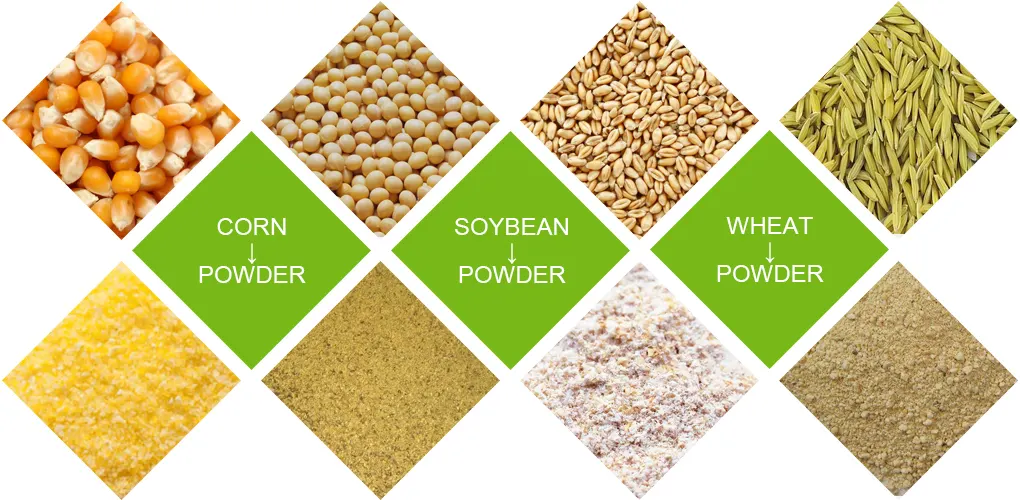
Yes. Particle size has a direct influence on mixing, conditioning, pellet formation, and final product quality.
Large particles may make the mixture less uniform, while excessively fine materials can sometimes increase dust or create other processing challenges. For this reason, grinding is normally carried out before mixing and pelleting.
A hammer mill is commonly used for grinding grains and other relatively dry feed materials. The screen size can be adjusted according to the characteristics of the raw material and the desired particle size.
Fibrous materials may require different preparation methods. Long straw, hay, or stalks generally need to be cut or crushed before entering the main grinding or mixing process.
The goal is not necessarily to make every ingredient extremely fine. Instead, the particle size should be suitable for producing a stable mixture and consistent pellets.
What Does a Typical Cattle Feed Pellet Process Look Like?
Although feed mills differ in size and configuration, the basic process usually follows several stages:
Raw material receiving → cleaning → crushing → batching → mixing → conditioning → pelleting → cooling → screening → packing or bulk storage
Each stage has a specific purpose.
Cleaning removes stones, metal, and other unwanted materials. Crushing reduces particle size. Batching ensures that ingredients are added according to the formulation. Mixing distributes the ingredients evenly.
Conditioning prepares the mixed feed for pelleting, often through the controlled addition of steam and moisture. The feed then enters the pellet mill, where mechanical pressure forces the material through a die to form pellets.
After pelleting, the product is hot and contains more moisture than the final storage specification. Cooling reduces temperature and stabilizes the pellets. Screening removes excessive fines, while qualified pellets can be packed or transferred to bulk storage.
Understanding this sequence is useful when planning a new facility because every machine needs to work as part of the overall process.
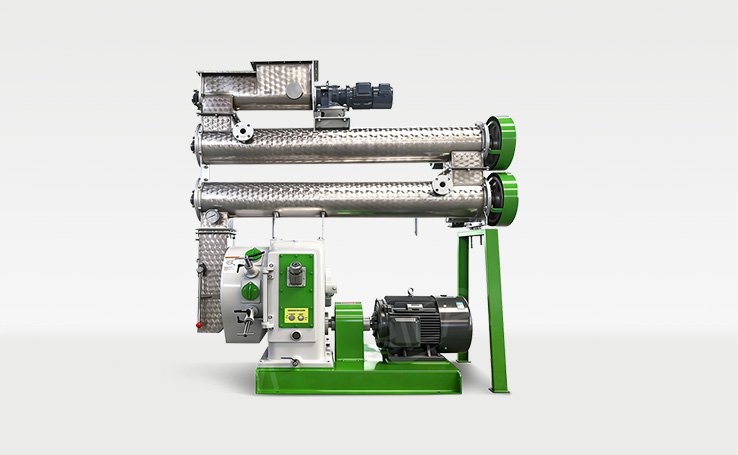
How Does a Cattle Feed Pellet Machine Work?
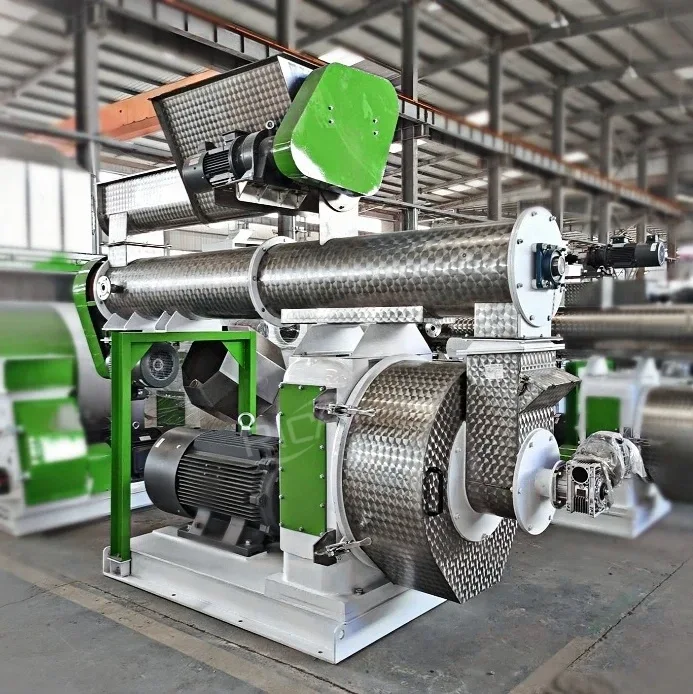
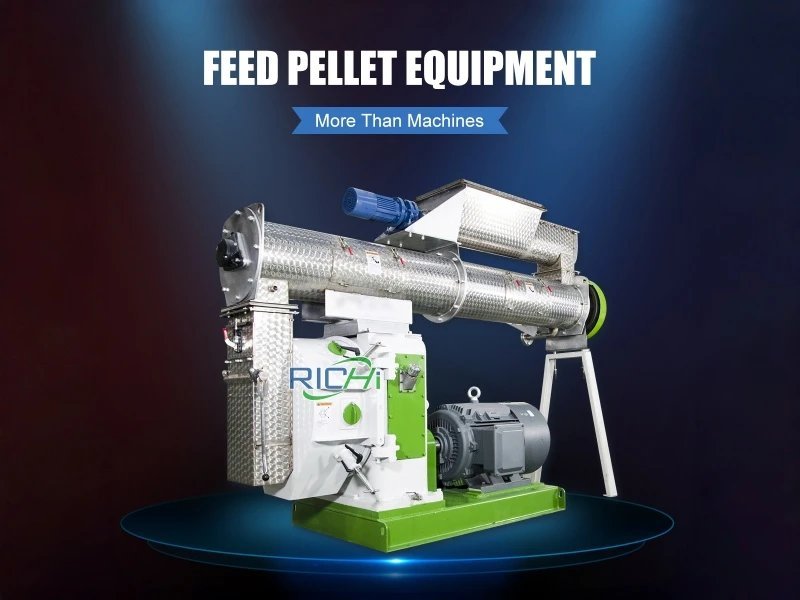
At the heart of the pelleting section is the cattle feed pellet machine, which compresses prepared feed materials through holes in a metal die.
Inside the pellet mill, the feed is continuously pressed by rotating rollers. As the material passes through the die holes, pressure and friction cause it to form compact cylindrical pellets. A cutting mechanism determines the approximate pellet length.
The diameter of the pellets depends mainly on the die specification. Different cattle feed products may use different pellet diameters depending on the age and feeding requirements of the animals.
Pellet quality is influenced by many factors, including raw material characteristics, moisture content, formulation, conditioning temperature, die selection, roller adjustment, and machine operating conditions.
Therefore, simply choosing a high-capacity pellet mill does not automatically guarantee good pellets. The equipment needs to be matched with the material and the rest of the processing system.
Does Cattle Feed Need Steam Conditioning?
Steam conditioning is common in larger and more automated feed mills because it can improve the physical characteristics of the feed before pelleting.
When steam is introduced into the feed, heat and moisture are transferred into the material. This can help soften particles and improve their ability to bind together under pressure.
Conditioning may also reduce the mechanical load on the pellet mill under suitable operating conditions. However, the appropriate temperature and moisture level depend on the formulation.
Not every small farm needs a complex steam-conditioning system. A small operation producing relatively simple feed may use a more straightforward process, while a commercial plant with higher throughput may benefit from a dedicated conditioner and steam system.
The decision should therefore be based on production capacity, formulation, pellet specifications, and the desired level of automation.
Is Liquid Addition Equipment Necessary?
Liquid ingredients are sometimes added to cattle feed for nutritional, formulation, or processing reasons. Examples can include molasses, oils, fats, and certain liquid additives.
Whether a feed line needs liquid addition equipment depends on the formulation. If the recipe contains no significant liquid ingredients, there may be no need for a dedicated liquid dosing system.
When molasses or oil is used, accurate dosing becomes more important. Uneven liquid distribution can affect both nutritional consistency and pellet quality.
For larger feed mills, liquid addition is often integrated into the mixing or conditioning section. Pumps, storage tanks, flow meters, pipelines, and spraying devices may be used to deliver the required amount.
For smaller plants, a simpler arrangement may be sufficient. The key is to make sure the equipment can deliver the required quantity consistently rather than adding unnecessary components to the production line.
How Large Should a Cattle Feed Production Line Be?
Production capacity should be selected according to actual demand rather than simply choosing the largest available system.
A small farm may only need a line producing around 1 ton per hour. A regional feed supplier may require several tons per hour, while a commercial feed manufacturer could need significantly higher throughput.
A useful starting point is to estimate the expected annual feed demand and the number of operating hours available each day. Maintenance, cleaning, formulation changes, and other downtime should also be considered.
For example, a line theoretically rated at 10 tons per hour will not necessarily produce 10 tons of finished feed every operating hour. Actual output depends on the formulation, pellet size, raw materials, machine settings, and operating efficiency.
This is why capacity calculations should be based on realistic production conditions rather than equipment nameplate capacity alone.
What Is a 20–25 Ton-Per-Hour Feed Line Suitable For?
For large commercial feed manufacturers, production capacity becomes an important part of the plant design. A 20-25 t/h livestock feed production line can be considered when the expected demand is high enough to justify a larger processing system.
At this scale, the plant normally requires more than simply a larger pellet mill. Material receiving, storage, conveying, batching, grinding, mixing, pelleting, cooling, screening, packing, dust collection, and electrical control systems all need to be coordinated.
The layout also becomes more important. Raw materials may arrive in bulk, while finished pellets may need to be stored in silos or transferred directly to packaging equipment.
A large-capacity plant can therefore be thought of as an integrated material-handling system rather than a collection of individual machines.
For smaller businesses, building a lower-capacity line and leaving room for future expansion may sometimes be more practical than investing in a very large system from the beginning.
How Long Does It Take to Build a Small Feed Production Line?
Construction time depends on the capacity, equipment configuration, building conditions, installation requirements, and degree of automation.
A simple small-scale line may have a relatively short installation period once the equipment arrives because the process contains fewer machines and simpler material-handling systems.
A larger plant generally requires more preparation. Foundations, steel structures, storage facilities, electrical systems, dust collection, conveyors, and control systems all need to be installed and tested.
It is useful to divide the project into several phases:
- Raw material and formula analysis
- Process design
- Equipment selection
- Workshop and foundation preparation
- Equipment manufacturing
- Transportation and installation
- Electrical and control system commissioning
- Trial production
- Operator training and final adjustment
Planning these stages early can reduce delays during installation.
What Should Be Considered When Designing the Workshop?
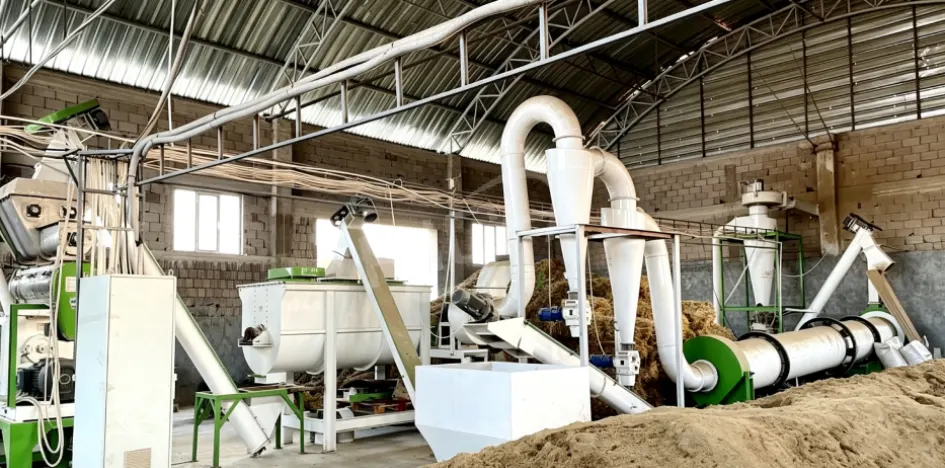
Workshop design should follow the production process rather than forcing equipment into an existing space without considering material flow.
Ideally, raw materials should enter the plant at a convenient receiving point and move through the process in a logical direction. Finished products should have a separate storage and dispatch area.
Vertical layouts can reduce the amount of mechanical conveying required because some materials can move downward through gravity after being lifted to an appropriate level. Horizontal layouts may be easier to construct in certain facilities but can require more conveyors.
Access for maintenance is another important consideration. Motors, bearings, screens, dies, rollers, and other wear components need to be accessible for inspection and replacement.
A compact layout is useful, but saving floor space should not come at the expense of safe operation and convenient maintenance.
How Can Pellet Quality Be Improved?
Good pellet quality begins before the material reaches the pellet mill.
First, raw materials should have reasonably consistent quality. Excessively wet or dry materials can affect processing stability. Second, particle size should be controlled through appropriate grinding.
Mixing is equally important. If minerals or other micro-ingredients are not distributed evenly, the final pellets may not have consistent nutritional characteristics.
Conditioning should then be adjusted according to the formula. Too little conditioning may result in weak pellets, while excessive moisture can create downstream drying or cooling problems.
Finally, the die and roller system should be maintained properly. Worn components can reduce production efficiency and make pellet quality more difficult to control.
In practice, pellet quality is usually the result of the entire process rather than one individual machine.
Should Feed Be Packed or Stored in Bulk?
Both methods have advantages.
Bagged feed is convenient for smaller farms and retail distribution. It is easier to sell in standardized quantities and can be moved using relatively simple handling equipment.
Bulk storage is more common in larger operations because it can reduce packaging labor and material costs. Silos can be used to store finished pellets before loading into bulk trucks or other transportation systems.
The decision depends on the target market and logistics. A commercial feed manufacturer supplying many small farms may need automatic bagging equipment, while an integrated livestock operation may prefer bulk storage and direct delivery.
Packaging should therefore be considered as part of the overall production and distribution strategy rather than as an isolated final step.
What About Dust Control?
Feed processing generates dust, particularly during raw material receiving, grinding, conveying, and screening.
Dust collection equipment can improve the working environment and help keep production areas cleaner. It can also reduce the amount of valuable feed material lost during processing.
Common dust-producing points should be identified during process design. A central dust collection system may be appropriate for a larger facility, while smaller plants may use simpler local extraction arrangements.
Good housekeeping remains important even when dust collection equipment is installed. Regular cleaning can help prevent excessive accumulation of fine feed particles around machinery and working areas.
How Much Does a Cattle Feed Plant Cost?
There is no universal price for a cattle feed plant because the total investment depends on capacity and configuration.
A small pelletizing line may require relatively limited equipment, while a complete commercial feed mill can include storage silos, multiple grinding systems, automatic batching, mixers, conditioners, pellet mills, coolers, screeners, packing machines, conveyors, dust collectors, electrical controls, and building structures.
Other project costs may include transportation, installation, civil construction, wiring, labor, and commissioning.
For this reason, comparing equipment prices without comparing the complete process configuration can produce misleading results.
A more practical approach is to define the required output, raw materials, pellet specifications, automation level, and packaging method first. Equipment and investment can then be estimated around those requirements.
How Can Operating Costs Be Controlled?
Feed production costs are influenced by raw materials, electricity, labor, maintenance, packaging, and transportation.
Raw materials usually account for a major portion of the final feed cost, so efficient formulation and purchasing can have a significant impact.
Electricity consumption is also relevant, particularly in grinding and pelleting. Proper equipment selection, reasonable motor loading, and regular maintenance can help avoid unnecessary energy consumption.
Maintenance should not be treated simply as an expense. Replacing worn screens, bearings, dies, and rollers at the appropriate time can help maintain production stability and reduce unexpected downtime.
Automation can reduce repetitive manual operations, but the appropriate level depends on the size of the plant. A small operation may not need the same automation system as a large commercial feed mill.
What Should Beginners Check Before Buying Equipment?
Before selecting equipment, it is useful to answer several practical questions:
- What type of cattle feed will be produced?
- What are the main raw materials?
- What is the expected production capacity?
- What pellet diameter is required?
- Is steam conditioning necessary?
- Will liquid ingredients be added?
- Will finished feed be bagged or stored in bulk?
- How much workshop space is available?
- What level of automation is appropriate?
- What power supply is available locally?
- How will raw materials and finished feed be transported?
These questions help narrow down the equipment configuration.
It is also important to ask whether the proposed machines have been designed to work together. A pellet mill with a high theoretical capacity may not perform efficiently if the grinder, mixer, feeder, cooler, or conveying system cannot supply and handle material at the same rate.
Where Can You Learn More About Feed Machinery?
When researching feed processing equipment, it is useful to look beyond individual machine specifications. Process diagrams, equipment configurations, completed projects, and explanations of different production capacities can provide a better understanding of how a feed mill operates.
If you are comparing manufacturers, you can look here to learn more about the company, its background, and the types of feed and biomass processing projects it works with.
The goal of this research is not simply to find the lowest equipment price. Instead, it is to understand which configuration fits the intended production conditions and whether the proposed process is practical for long-term operation.
What Makes a Practical Cattle Feed Production Line?
A practical production line should balance production capacity, product quality, operating costs, maintenance requirements, and future expansion.
For a small farm, simplicity may be more valuable than extensive automation. For a commercial manufacturer, automated batching, centralized control, larger storage capacity, and efficient material handling may become increasingly important.
The raw materials should also influence the design. A plant processing mostly corn and soybean meal will have different preparation requirements from one handling large amounts of straw, alfalfa, or other fibrous materials.
Equipment manufacturers with experience in different raw material combinations can help translate these requirements into a suitable process configuration. For example, RICHI Manufacture provides feed processing equipment and complete production-line solutions covering different capacity ranges and applications.
However, the final configuration should always be based on the specific formula, raw materials, target output, workshop conditions, and local operating requirements.
Final Thoughts
Producing quality cattle feed pellets involves much more than selecting a pellet mill. Raw material preparation, grinding, batching, mixing, conditioning, pelleting, cooling, screening, storage, and packaging all contribute to the final result.
For small farms, a relatively simple production process may be sufficient. As output increases, more attention needs to be given to automated dosing, material handling, storage, dust control, cooling, and process management.
The most useful approach is to start with the feed itself: determine the target cattle group, formulate the ration, study the available raw materials, estimate realistic demand, and then design the processing system around those requirements.
With a properly matched process, feed pellets can be produced more consistently while making handling and storage easier. More importantly, a well-planned feed mill gives producers greater control over their raw materials and production process, which can be valuable as the operation grows.